The Truth About South Dakota’s Property Taxes and Government Spending

Would you vote for a politician who could guarantee you would pay less taxes than people do in 45 of the 50 states?  Sound too good to be true?  Read on.

Such a plan would have to find the right balance between sales tax, property tax, excise tax and income tax. 

On the worst end of the spectrum, is Hawaii with a 13.92% total tax burden.  On the other end, Alaska, with a total burden of 4.93%

Taxes fund government services such as roads, emergency response, schools, utilities, courts, social services and costs related to expansion, such as extending infrastructure.

Of course, we have heard a great deal about property taxes already this election season, and there is at least one gubernatorial candidate who claims he will eliminate property taxes. But why the focus on just property tax?  It’s not the only tax we pay in America, or in South Dakota.   

Every election cycle needs its villain. Sometimes it’s Washington. Sometimes it’s “the elites.” And in South Dakota, it’s property taxes —as if we’re living under some Scandinavian-level tax regime.

Except we’re not. Not even close.

Let’s start with actual data, because facts don’t lie.

When you look at overall state and local tax burden — property taxes, income taxes, sales taxes, excise taxes, the whole package — South Dakota ranks fifth from the lowest in the entire nation. Forty-five states take more from their residents, measured as a share of personal income. Only Alaska, Wyoming, New Hampshire, and Tennessee are lower.

But that’s not the message in political ads. The message often is – Mrs. Smith is being taxed out of her home due to property taxes. But that doesn’t tell the whole story.  First, Mrs. Smith is a widow and collects only social security.  She didn’t invest, she didn’t belong to a career pension program and she didn’t have rich relatives.  An all too common story.  Plus, she is still living in the family home with four bedrooms, three baths on 5 acres.  Property values have indeed increased and likewise so have government budgets.

I hate it when people try to argue both sides of the argument, presented as one.

  • For example, on one hand: Mrs. Smith should not be taxed out of her home.  The government should do something for her so she can live there unburdened from tax obligations. On the other hand:  Government welfare is wrong.  Let those people sink or swim.
  • Another: On one hand, Families are struggling with inflation and need more income just to maintain the same standard of living. On the other hand, we’re told government spending is “out of control” and must be rolled back to pre-inflation levels.

These two claims cannot both be true in isolation. If inflation increases the cost for food, labor, fuel, and materials for households, it does the same for government. Roads do not get cheaper to build, employees do not cost less to pay, and infrastructure doesn’t revert to 2019 prices simply because we wish it would.

These two claims cannot both be true in isolation. If inflation increases the cost for food, labor, fuel, and materials for households, it does the same for government. Roads do not get cheaper to build, employees do not cost less to pay, and infrastructure doesn’t revert to 2019 prices simply because we wish it would.

What’s truly baffling is how the loudest complaints about “runaway government spending” often come from the same people who complain that roads are falling apart, infrastructure isn’t keeping up, and services aren’t good enough. Government is somehow spending too much and not doing nearly enough.

Now enter legislative and gubernatorial candidates promising to eliminate property taxes. These proposals are usually light on detail and heavy on applause lines. Rarely do they explain what stands to get cut instead: schools, counties, roads, or emergency services. Or do we just assume the money fairy fills the gap?

Property and other taxes fund local government — schools, counties, townships, and infrastructure people rely on daily. You don’t fix that by removing the load-bearing beam.

We can’t have it both ways.  Government experiences Inflationary increases just like every other entity or individual. Those increased costs are passed down to the customer, just as it is with every other entity. Only when it’s government, it’s a sin.  

So when I hear breathless rhetoric about South Dakota being “taxed to death,” I have to ask: Compared to whom? Hawaii? New York? California? Vermont? Those states have nearly double the overall tax burden South Dakotans carry.

Property taxes have become the political equivalent of a haunted house: scary sounding, emotionally charged, but wildly disconnected from reality. Are property taxes noticeable? Of course. They arrive in one or two big bills, which makes them feel painful. But feeling pain from a tax is not the same as being overtaxed.

South Dakota is one of nine states that have no personal income tax. States without income tax fund government differently, leaning more heavily on sales and property taxes. Only two of those states have lower property taxes than South Dakota – Nevada, with 6.85% sales tax and Tennessee with 7.0% sales tax. South Dakota sales tax is 4.2%.  

Here’s the uncomfortable (for political candidates) truth: South Dakota is not a high-tax state. It’s not even a medium-tax state. It is one of the lowest-taxed states in the nation.

We are fortunate to live in a state that has kept taxes low while still functioning. That balance won’t survive unserious policymaking fueled by manufactured outrage.

South Dakota isn’t a cautionary tale of over taxation. It’s a reminder of how easy it is to complain loudly even when the numbers say we’ve got it pretty good.

Primary Source:  Tax Burden by State in 2025
Rapid City’s Only Development Tool

Different cities have different development strategies.

Some cities prescribe development. They do studies, create zoning laws, and fund public infrastructure in the direction they want the city to develop.

In this case, a developer usually pays only a development fee or hook-up fee for the public infrastructure. Sioux Falls is a great example of this. Development is driven by the government planning function, which includes the input of elected representatives and always includes public meetings and opportunities to comment.

The positive side of this for the developer is that the public infrastructure is in place and the zoning of the land is predetermined. It can also be the negative side. A developer may want to purchase a parcel of land for commercial development and may be told that this is not acceptable to the city because the parcel is zoned residential or industrial.

Given the pros and cons, this is the more orderly method of development. This method also allows the public to experience the benefits of the city’s strategic planning function.

The other type of development is one we see in Rapid City. That is where the developer purchases land and then seeks to change the zoning in some cases to what they feel is appropriate. Also, the developer determines in which direction the city will expand. It could literally be north, south, east, or west.

The upside of this style of development is that the free market appears to be in charge. This tests the boundaries of limited government. This style of development appears to be freer and more driven by consumer demand as interpreted by the developer.

The downside of this style of development is that public infrastructure is rarely in place when the project is ready to go. The question becomes: whose responsibility is it to develop and fund public infrastructure?

Rapid City uses tax increment financing (TIF) to create funds for public infrastructure and/or required improvements to the area.

Although complicated, the simplest version of this procedure is:

A tax increment district is developed. This encompasses the property to be developed and a contiguous larger area with undeveloped property. Once approved, all the undeveloped property continues to pay property taxes, which go directly to the city, county and state. The developed property within the area also continues to pay property taxes to the city, county and state – just as always. As the undeveloped property develops, and more property taxes are collected, the incremental change in taxes flows through the county, into the developer’s loan.

A note worth emphasizing: the developer gets a loan from the bank of their choosing for required public improvements. If the property fails to develop or the area does not develop in a way that satisfies the loan requirements, the city is not on the hook—the developer is. The city is at 0% risk in this instance.

Tax increment financing arrangements can last up to 20 years, but in Rapid City they are typically paid off closer to the 10-year mark.

The opponents of tax increment financing falsely believe their property taxes will go up as a result.

They also falsely believe that TIFs are a government subsidy. This is not so, as the public infrastructure being constructed will belong to the government and the citizens within that government’s jurisdiction. The infrastructure will not belong to the developer.

There is a great amount of false information swirling about how tax increment financing hurts the taxpayer. The only people that it hurts are those that hate government and think it’s unfair for “rich developers” to have any financial tools available to them. They also wish to resist expansion. If you ask me, it’s a liberal mindset recast as a conservative complaint.

At this point, the usual suspects are gathering signatures and misinforming potential voters about the issue. A special election on this issue will cost voters around $100,000. That’s exactly $100,000 more than it will cost voters if the Liberty Land tax increment financing district is approved and moves forward.

Please get your information from reliable sources, and not the group of people who protest everything in our community.

Steve Allender served as Mayor of Rapid City from 2015-2023

The Uninformed vs. The Misinformed

Here’s a small example of someone who’s apparently angry about something they know little about. All too common in this world overloaded with too much information:

He’s concerned that Rapid City’s “7% Vision Fund tax” needs to be done away with – and of course the roads fixed to perfection.

Well, if the Vision Fund tax was 7%, I would agree it needs to be eliminated. But it’s not – it is 1/2 of one percent. That’s .5% not 7%. It’s 1/2 of .01 cent, not 7 cents on the dollar. So how did this person get it so wrong? How did they inflate the tax by 1300%? The answer seems obvious.

This person is either uninformed or misinformed. If they are uninformed, they used their ignorance of the issue to lash out publicly… to vent unintelligibly. The anonymous Two Cents forum attracts such comments, as do other anonymous social media forums. But this person is in good company:

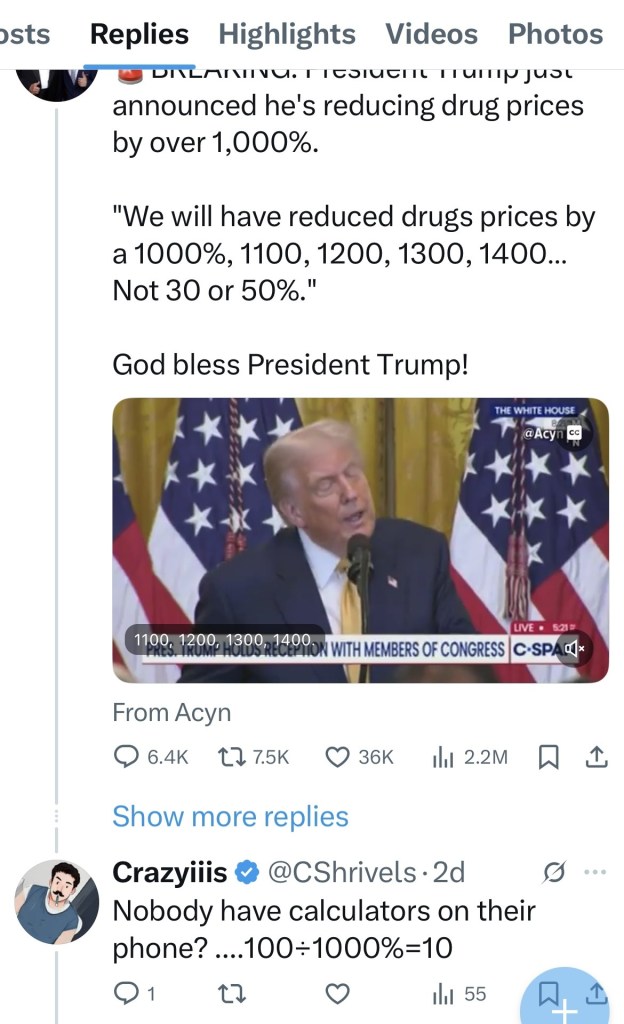
Recently President Trump announced that prescription drug prices were going to be reduced by “1000%, 1100%, 1200%, 1300%, 1400%” and ” not 30 or 40 or 50%, but numbers the likes of which you’ve never even dreamed of before.”

Well, he’s right about one thing, I have never dreamt of the pharmacy paying me to get a prescription filled. If you think about it:

A prescription that costs $50, if offered at 50% off would cost $25.00. If offered at 100% off would be free. If offered at 1400% off …… the cost would be -$650. Thats negative $650. In other words, the pharmacy would owe you $650! So where did the President come up with these figures? Who knows, but what is truly shocking is that people defended him on social media. One commenter posted “Nobody have calculators on their phone? …. 100-1000% = 10.”

I asked ChatGPT to explain how something could be reduced by 1000%. The response was: “1000% off is mathematical absurdity” and further “any claim of 1000% off is either a joke, a mistake or marketing nonsense.”

So why would people believe things like this? Why does the person believe the Vision tax is 7%? This is the problem without a solution, but the internet obviously has undue influence or is taking the place of people using their own brains to form opinions.

It is estimated that 20% of all social media interactions are the doing of Bots (software that performs automated tasks). So when internet ramblings occur, and people blindly believe what they read or hear, then people are misinformed. It is also estimated that in 10 years, as much as 70% of social media interactions will be bots. The question need to ask yourself is: why are the bots posting on social media?

A 2023 paper from the University of Southern California projected that if current bot development trends continue, bot posts will outnumber human posts by 2030.

Will the internet ever lose credibility? I doubt it. Because the chronically uninformed are always seeking to be informed and misinformation satisfies that – especially if they can blab on about it, in an anonymous platform.

The internet is an excellent place to acquire knowledge and find soluti0ns to problems, but great care must be used, in other words one must still use their brain to vet that information.

Follow @theother98cents on “X” (formerly Twitter)

Political Parties are not our Friend.

To avoid arguing, don’t discuss religion or politics. This age-old advice has probably never been more accurate but at the same time, never been more ignored.

Political discussions have become toxic, maybe more so since 2016, and especially since the onset of the COVID-19 pandemic.

Even in South Dakota, which only has three electoral votes, and will likely never be a determining factor of a presidential election, we argue at the expense of community, friendships, and family relationships. It makes even less sense in our area of the state, which is nearly all Republican, that we argue and fight over partisan politics, like never before.

The difference between this era and past eras of political debate? Today it’s more personal.

Friendships and even families have been fractured by differences in political viewpoints. Members of one political party are labeled as evil or otherwise defective by the other party. Members are grouped together and associated with the most radical element of their party.  Guilt by association.

25% of South Dakota voters have chosen to register as “independent” or have chosen to not designate a political party.  This percentage of non-party voters is growing. The reason for this, in large part is based on their unwillingness to affiliate with one party or the other on ethical or moral grounds. And who could blame them?

The political parties have been working diligently to prove to all of us that they are not our friend. There was a reason George Washington warned against partisan division, and resulting elections. It does not unite, but rather divides along social, as well as political lines.

We are just over two months until the presidential election. As a lifelong Republican, I am watching as the Republican party does their best to put another Democrat in the White House for four more years. The political parties, led by their most extreme factions, have lost touch of the best interests of America.

Political party support is now being framed as a quest for a ruling class, rather than a group of people who share political ideologies and preferences. Both parties are guilty of this. And we are all guilty for allowing it to happen.

Next up: How to help change this.

Steve Allender is a former mayor and former police chief from Rapid City, South Dakota

Social Studies Standards – I Said What I Said

During the March 6th Rapid City Council meeting, a council member presented a resolution to oppose the newly proposed social studies standards for the K-12 public school system. The standards are being proposed through the governor’s administration.

A City Council resolution in this matter is merely a statement expressing the City Council’s position on an issue.  It’s not law; it carries no procedural or policy weight.

After several public comments asking for the resolution to be passed, and after roughly half the city council making comments, the council deadlocked on the issue, with a 5 to 5 tie. In this case, the mayor becomes the tiebreaker and I voted to pass the resolution. Prior to doing so, I made a five-minute speech, which has earned me some hate mail. One of them is below:

Degenerate scum? I beg to differ. Everything else? I also beg to differ. No facts here, just hate.

The proposed social studies curriculum standards should be rejected. The standards are not realistic. They are based on political idealism as opposed to the science and practice of educating young human beings.

It should be noted that the current social studies standards are a product of the South Dakota Social Studies Content Standards Revision Committee of 2014.  That committee consisted of 35 individuals, 31 of which were educators. In other words, 88.5% of the committee were educators.

The Social Studies Standards Revision Commission, responsible for the proposed standards, consists of 16 individuals, only 4 of which are current or retired educators. In other words, 25% of this commission are educators.

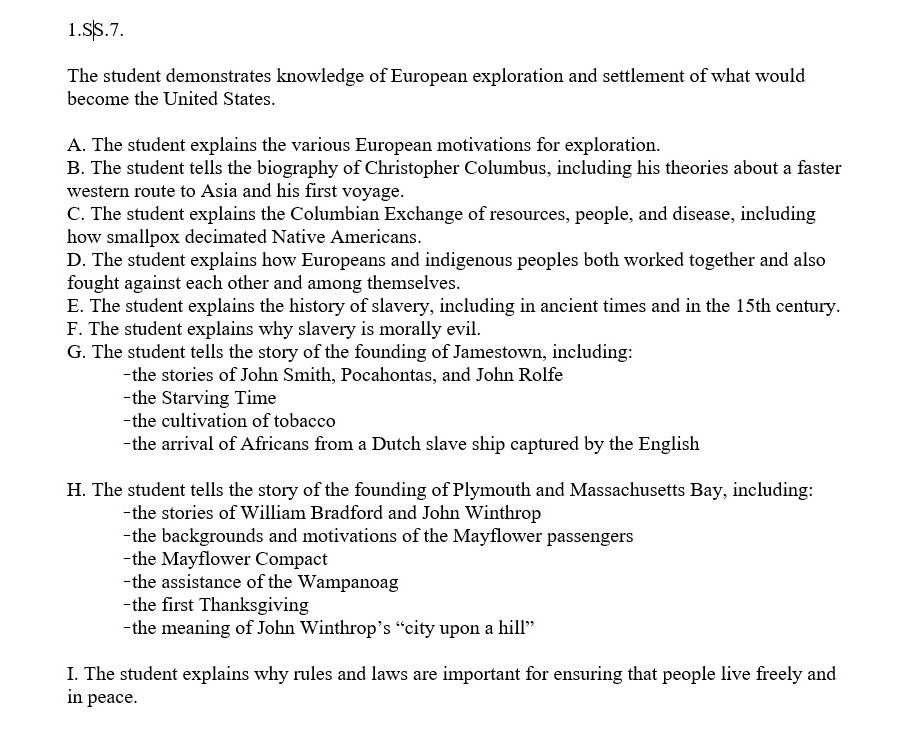
Below is just one example of the proposed history standards for a first-grade student- a six or seven-year-old human being:

You can view the proposed standards here. I dare you read the standards in their entirety.

Although the standards seem to me to be ridiculous from an academic standpoint, they do not have the endorsement of the people who are actually trained how to teach your children.

But there is even a dumber part to this whole story, which is of course, that social studies are not a part of the standardized testing. This means, there will be no accurate measure that the standards are being implemented or if they are being absorbed by the student. So what’s the point of it all?  Political gamesmanship is my best guess, but you are entitled to your own opinion.

As a Republican and as a public servant of 40 years, it appears a main emphasis within the proposed social studies standards has to do with protecting America from liberals. The weapons being used in this political war are teachers and students. Looking to politically suitable advisors rather than certified and experienced educators is folly and there is evidence this is counterproductive to Conservative Republican values.

During World War II, there was a study of 5.2 million draftees. It was determined that 36% of the draftees were unfit for military service and were therefore rejected. In a later study, it was learned that many of the rejected draftees had suffered from ailments that were brought on by malnutrition. If you think about it, the draftees were toddlers or grade school kids when the Depression started.

In 1945, President Truman started the school lunch program, as a result of the draftee study. So, pay attention to this: the government identified the problem and implemented a solution.

In a 2009 report, it was determined that 75% of Americans aged 17 to 24 we’re unfit for military service. More recently that number is reported to be 77%, but discussing this with Armed Forces leaders, they suggest it is now 80%.

Put another way, of the 36 million Americans between 17 and 24, 28 million of them couldn’t serve if they wanted to. The primary reasons? NOT Malnutrition. Obesity, poor education such as basic math and reading skills, and mental and physical conditions that would prevent them from serving.  The military branches are drastically short of their recruiting goals.

This is fast becoming a national security issue.

A group of 90 former generals, admirals, other officers and senior enlisted personnel, agree that early childhood education is the answer.  So again, the government has identified a problem, but where is the solution?  Lost in the political war that rages on in this country, that’s where.

South Dakota is one of just a few states that will not commit to early childhood education programming, even though there is ample funding for it. Ironically, people of the same political persuasion that support a strong military do not support early childhood education or other programs that will keep America’s kids healthy and smart and able to serve. If South Dakota is so concerned with our kid’s educations, why not start with three-year-olds? There’s a lack of understanding that may be due to hyper-political rhetoric resulting in plugged ears and closed minds.

This too, divides us.

The division of America will not make us stronger. It will only make us weaker and make no mistake: it will please our foreign enemies. Extreme right-wing and extreme left-wing politicians are doing everything within their power to create two Americas: The Un-united States.

And I assume most folks are going to sit by and watch it happen. Some people will throw their hands up and refuse to vote because of perceived disenfranchisement, while some will think of the division as progress. In the end, we all lose.

I currently serve as the mayor in a non-partisan government organization. The non-partisan feature is the only thing that appealed to me when I made the decision to run for office. The problems in our communities will never be solved only from the Republican or Democrat handbook. Problem-solving requires ingenuity, flexibility and cooperation.

Causing problems on the other hand, requires nothing other than ignorance.